

Investit Academy
Commercial Real Estate Microcredential Program
Overview and Course Outlines
Introduction
Investit Academy has created a comprehensive online and in-house Commercial Real Estate Education Microcredentials program.
Learn more. https://investitacademy.com/
Neil Osborne 604-988-9964 nosborne@investitsoftware.com
Target audience
Anyone interested in preparing for a career in commercial real estate, such as becoming a commercial realtor or leasing agent, working for a developer, becoming a commercial mortgage broker, working for the commercial division of a bank, credit union or City, or any organization that has a real estate division.
About the creator
Neil Osborne has many years of experience teaching varieties of real estate and related financial topics to all levels of students and practitioners in the Commercial Real Estate industry.
Testimonial. “His style, and easy to understand real-life examples, enables him to present complex concepts in ways that make the topics “user friendly” practical and relevant.”
For a number of years, Neil was a managing partner of the real estate and development division of a multi-dimensional real estate firm involved in architectural and engineering design, commercial real estate sales and leasing, property management, construction management, and development. He is a retired Professional Engineer and has an MBA and a Diploma of Urban Land from UBC
He has developed and taught courses on commercial real estate, investment, development, and lease analysis for over 30 years to residential and commercial associations and CCIM Chapters in Canada and the USA. The National Association of Realtors (NAR) selected him to present at the 2008 national conference. That presentation was so successful that NAR asked Neil to present again at the 2009 convention in San Diego.
The Investit Academy Commercial Real Estate Microcredential Program
There is a lot to learn when embarking on a career in commercial real estate.
The program consists of six courses which can be viewed on one video or a series of micro videos along with the matching manual.
Core courses
- 101. How to analyze and value income properties (3-1/4 hours)
- 102. Real estate investment analysis (3-1/4 hours)
- 103. Development analysis and valuing land (4-3/4 hours)
Elective courses
- 201. Applied real estate investment and lease analysis (4-1/2 hours)
- 202. Creating and profiting from joint ventures (3-1/4 hours)
- 203 Office, industrial and retail leasing (3 hours)
Each Video comes with a comprehensive workshop manual for guided note taking.
The courses cover all aspects of commercial real estate.
- Investment properties
Office, industrial, retail, mixed-use, and rental apartment buildings - Leasing. Office, industrial and retail space
- Development. Income properties, condominiums, land subdivisions, and phased developments
The Investit Academy approach to learning
The Investit Academy recognizes that each person has a preferred way of learning and limited time to learn, which has led to the design of the following educational activities:
- Videos and Manuals. The manual allows the student to follow along with the video and take notes for later reference
- Micro videos. Short educational video segments allow the student to choose a topic of interest. Learn what they need, when they need to learn it.
- Flashcards. A great way to learn basic terms, definitions, and calculations.
- Practice Quizzes and Mastery challenges. Allows the students to regularly test their understanding of the course material. The practice quiz grade is recorded, allowing the student to measure their progress and identify their learning needs.
- Our unique micro-video program makes learning fast, convenient, and effective. Learn exactly what you need to know in just minutes, and then measure your progress as you go. It’s the proven way to learn more effectively.
Exams
Competency test
Tests the student’s understanding of the basic commercial real estate terms, definitions, and calculations.
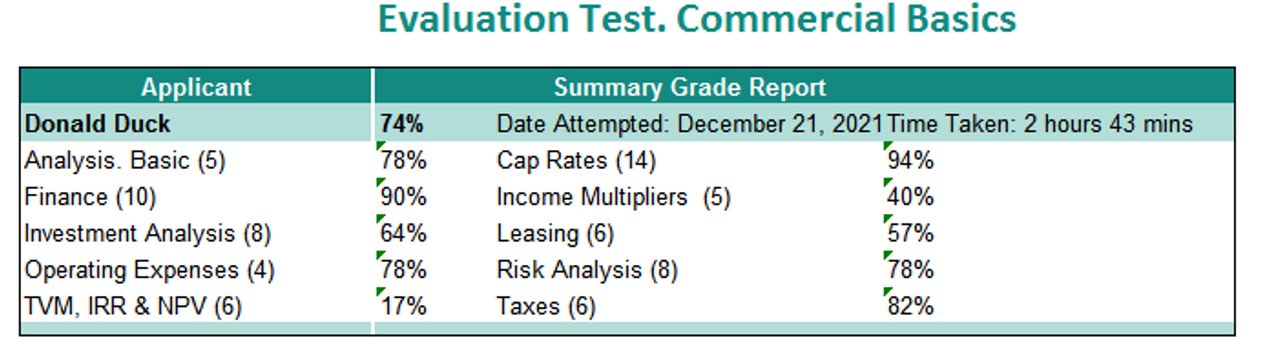
Provides input for hiring decisions and developing training needs, a mentoring plan, and measuring progress. The competency test result is broken down by “Question Type” which helps identify training and mentoring needs. Similar reports are available for the course exams.
Exam and Practice Quiz reports
The exam and practice quiz report grades are broken down by question categories allowing the student to measure their progress and identify their educational needs.
Example exam report
Exam and Quiz Bank
There are over 600 quiz questions used to generate course exams and practice quizzes.
Achievement recognition. Digital Badges
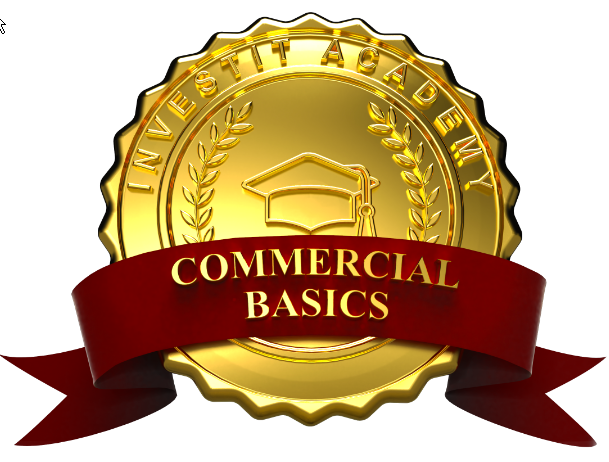
When a student passes the course exam with a grade of 75% or higher, they are issued a “Digital Badge” recognizing their well-earned achievement. Clicking on the “Digital Badge” displays the course name, student name, course description, the criteria for issuing the “Digital Badge”, date issued and a link to the course outlines.
Digital badges can be posted to LinkedIn and Facebook pages, websites and profiles and used for promotion and branding.
In-house training made easy
Deliver group and individual training classes with our hands-off in-house system. Our done-for-you training program provides a complete training plan and comprehensive resources. It’s dead simple. No outside consultants and hardly any staff involvement is needed.
The teaching process consists of alternating between playing the:
- Micro videos, Flashcards, answering the flashcard questions, and lively class discussions
by following the “Agenda Time Table” in the Instructors Guide
Teaching resources include:
- “Instructors Guide and Agenda Time Table” and “Participant Guide”
101. How to Analyze & Value Income Properties. Video Time: 3-1/4 hours
Learning objectives
This video introduces the fundamentals of real estate investment analysis and discusses the issues, complexities and dangers involved in listing and selling commercial properties.
Specific objectives are to:
- Provide a good understanding of the basic financial measures used to evaluate and determine the value of rental apartment buildings and commercial properties.
- Explore the advantages and disadvantages of the most used financial measures.
- Demonstrate how to analyze and adjust Income & Expenses Statements and what expenses need to be included when using Cap Rates to determine the property value.
- Provide an in-depth overview of the capitalization rate as it is used in commercial real estate, and to explain the factors that influence the Cap Rate
- Show how to analyze apartment and commercial buildings and how to re-do the financial statements so that they more realistically reflect the financial performance of the buildings.
- Provide an introduction to risk analysis and financial ratios for measuring risk
- Show how to read a lease and discuss important terms / clauses in the lease that can affect the value of a commercial building
- Provide an understanding of the weakness of using Cap Rates with a brief introduction to long term real estate investment analysis
- show how to identify properties that may be hard to sell because of income tax consequences
- Show the importance of having a professional engineer perform an assessment of the building on behalf of a buyer, by using real-world examples
Skills and benefits obtained from the course
- How to analyze and restructure “Income & Expense Statements” so that they more realistically represent the financial performance of the property
- Use the various financial measures such as the Gross Income Multiplier, Cap Rate, Cash on Cash, Default Ratio, Debt Coverage Ratio etc., to analyze and value an income property and appreciate the limitations of these simplistic approaches to analyzing and valuing income properties
- Understand the different types of leases and rent
- Carryout risk analysis
- Determine potential loan amounts
- Communicate effectively with other participants in the commercial real estate arena such as realtors, investors, lenders and mortgage brokers, appraisers etc.
- Understand how important it is for the buyer of income properties to obtain professional engineering, tax and legal advice
The knowledge and skills developed during the video will improve your ability to understand, analyze value, finance and manage income properties.
102. Real Estate Investment Analysis. Video Time: 3-1/4 hours
Learning objectives.
The overall objective is to provide an understanding of how to carry out in-depth real estate analysis investment analysis and how to apply investment analysis techniques to different types of properties or types of real estate.
Topics
- The significant weaknesses in using Cap Rates to make real estate investment decisions compared to the discounted cash flow approach. Examples illustrating the disadvantage of the Cap Rate approach to establishing value
- Time value of money concepts. The Internal Rate of Return (IRR) and Net Present Value financial measures and discounted cash flow analysis
- Steps involved in carrying out long term real estate investment analysis and discounted cash flow analysis
- Real estate taxation. Overview
- Impact of financial leverage on the investment return and investment risk
- How to use real estate analysis techniques to help list, sell, finance, lease or invest wisely
Skills and benefits
- How to:
- Carry out and apply in-depth real estate analysis to different types of income properties
- Determine the value of an income property using the discounted cash flow analysis approach
- Assess the investment risk
- Financially structure a real estate transaction using creative financing
- Identify income properties that are hard to sell because of the tax implications on sale or mortgage restrictions and penalty costs that make it difficult for the owner to sell the income property
The knowledge and skills developed will improve your ability to analyze, value, list, sell lease or manage income properties and how to use investment analysis techniques to put deals together.
103. Development Analysis and Valuing Land Time. Video 4-3/4 hours
Learning Objectives.
The overall objective of the video is to provide an understanding of:
- how to carry out development analysis to determine land values for unit projects such as land subdivisions and condominium projects, and for income properties such as office buildings
- the issues and difficulties associated with determining land value
Topics
- Issues related to using simplistic approaches, such as $ per Acre or Sq. Ft to value land
- The backdoor or land residual approach to valuing land
- Factors that affect land values. Examples are illustrated using photographs
- Soil conditions
- Architectural, design & zoning constraints
- Market and design considerations
- Development Analysis Case Study. Condominium development
- Development Analysis Case Study. Retail center development
- Sensitivity & Risk analysis. What numbers have the biggest impact on the development profit?
- Analyzing a “Mixed” unit and income property development. Case study
- Income property development. Sell or hold analysis
- Renovation analysis
- Profitability analysis and ratios & assessing the development risks
- Quick Proforma approach versus detailed monthly cash flow development analysis
- Construction loan requirements
- Offer to Purchase versus Options. Pros & cons.
- Tips for creating an offer & keeping the offer together
- Land assembly and analyzing sites with assembly potential
Skills and benefits obtained from the video
- How to analyze development sites and determine land values using the development analysis approach
- Appreciate the difficulties and uncertainties in determining land value
The knowledge and skills developed during the video will improve your ability to value, list, finance, and sell development sites or manage development projects.
Video: 201. Applied Real Estate Investment & Lease Analysis. Video Time: 4-1/2 hours
Learning objectives.
The overall objective of the video is to provide an understanding of how to carry out in-depth real estate analysis investment and lease analysis, and how to apply investment analysis techniques to different types of properties or types of real estate decisions.
Topics
- Investment analysis. Getting started. Questions to ask.
- Applying the Internal Rate of Return (IRR), Net Present Value (NPV) and Modified Internal Rate of Return (MIRR) to real estate investment decisions
- Issues and challenges related to calculating the Internal Rate of Return (IRR)
- Exploring potential financing now and in the future
- Risk analysis and management
- Real estate analysis. Tips and tricks
- Lease analysis and lease comparisons from a landlord and tenant perspective
- Lease negotiations. Case study
- A framework for exploring creative financing explained using a case study
- Buy versus Lease analysis. & Hold versus Sell case studies
- Valuing land leases
- Replacement reserve planning
Skills and benefits obtained from the Video
How to:
- carry out and apply in-depth real estate analysis to different types of income properties
- determine the value of an income property using the discounted cash flow analysis approach
- analyze and manage risk
- develop presentation packages and executive summaries
- financially structure a real estate transaction using creative financing
- perform lease comparison analysis from a landlord or tenant perspective
- make Buy versus Lease and Hold versus Sell decisions
- develop replacement reserve schedules
The knowledge and skills developed will improve your ability to value, list, sell, lease, finance or manage income properties and how to use investment analysis techniques.
As an investor, how to determine the value based on your desired return and make wise investment decisions.
Video: 202. Creating & Profiting from Joint Ventures. Video Time: 3-1/4 hours
Learning objectives.
This Video assumes that those attending understand the basics of real estate investment analysis or have completed the course “201. Applied Real Estate Investment & Lease Analysis”.
The overall objective of the Video is to provide an understanding and present a framework for analyzing and structuring joint ventures using case studies.
Topics
- Provide an introduction to the nature and characteristics of joint ventures
- Show how to use joint ventures to structure deals and earn commissions and/or profits
- Provide a universal framework for thinking about, analyzing and structuring joint ventures
- Demonstrate joint venture creation and analysis using case studies and solution guides
- How to analyze complex investments such as syndications, equity participation deal and waterfall distributions
Skills and benefits obtained from the Video
The knowledge and skills developed will improve your ability to analyze and structure joint ventures by providing a framework for analyzing joint ventures and give you lots of ideas for putting joint ventures together.
Video: 203. Office, Retail and Industrial Leasing Time: 3 hours
Learning Objectives.
To provide a comprehensive understanding of:
- The leasing process and terms used in leasing
- How to read a lease and what to look for in a lease
- The differences between the different kinds of leasing markets
- How tenants go about choosing a location and space
- What question to ask the landlord and tenant
- Some of the complex issues involved leases and lease negotiations
- Why leases are often complex, lengthy documents
- How to carry out lease comparison analysis from a landlord & tenant perspective
Topics
Following is a summary of topics that will be covered.
- Overview of landlord and tenant leasing objectives
- Tenant compatibility considerations and issues
- Leasing characteristics by different types of properties
- The leasing process and documents
- Types of Leases
- Gross & Modified Gross Leases, Indexed lease, Triple Net Lease
- Expense Caps and Stops and Rent Caps</li
- Types of Rent
- Base Rent & Additional Rent or Recoverable Expenses
- Free Rent
- Percentage Rent
- Areas and Area Measurement
- Rentable and Usable Areas and Load Factor
- Space Measurements and the BOMA Standards
- How to measure different types of properties
- Issues related to measuring space
- Leasing new space. Tenant Improvements and build outs
- Assignment & Subletting
- Operating Expenses, Recoverable Expenses and related issues and considerations
- Renovating and subdividing space including structural considerations
- Lease Comparison Analysis and the Net Effective Rent from landlord & tenant perspective
- Case Study. Comparing three different lease arrangements
- Valuing ground leases.
- Blending and extending a lease
- Impact of leases on the property value and marketability
- Tips for reading leases
- Leasing as a career
Skills and benefits obtained from the video
- Increased knowledge of lease terms and the leasing process
- The differences involved in leasing office, industrial and retail space
- A deeper understanding of the complex issues related to leasing
- How to compare leases from a landlord or tenant perspective
The knowledge and skills developed during the video will improve your ability to analyze and negotiate and leases from a tenant or landlord perspective.
Unsolicited Testimonials
From NAR RCA staff member. First of all, since you received raved reviews during your session last year in Orlando at the 2008 REALTORS® Conference and Expo, we wanted to make sure you have the opportunity to be show cased at our annual conference this November in San Diego! Have you submitted your speaking proposal to our conventions division as of yet? If you need assistance with this process, I’m happy to help.
Thank you very much for the wonderful Video presentations. You definitely raise the bar for excellence in our industry. Dr. Kathleen Kagawa President and CEO the Hawaii 5-0 Group Past commissioner. Hawaii Association of Realtors
What a fabulous Video! I learned more in the 5 sessions than I have ever learned at any Real Estate conference I have attended! Thank you for the insight and great real life examples of properties and business opportunities. The information was extensive. Also, please let me know when and where your next video will be held and we will certainly try to be there. Jo-Ann McLellan Smith McLellan Group Royal LePage Kelowna
Neil, I would like to thank you for the wonderful presentation you provide at the Video on “Raising your commercial IQ”. I found the sessions very informative and especially the examples that you provided made the concept easier to follow. I also found the concept of Video worked very well. I was in fact in Whistler throughout most of the sessions and it was great to be able to participate and take advantage of your vast knowledge and experiences without having to physically attend. I will definitely look forward to more of these sessions on any topics you can address and will encourage all the agents to participate as well. Regards, Nika Rohani RE/Max Commercial Advantage
Hi Neil, I enjoy very much your presentations and I am learning a lot. You are such a great instructor and we need many more professors like you. Thank you so much, Jorge Fajardo
Both sessions have been great. W. Michael Lewis, CCIM, SIOR President The Lewis Group/CORFAC International
Excellent presentation! I’ll sign in again tomorrow.
Paul Ferri Sales Representative, I.R.E.S. RE/MAX Unique Inc., Toronto
Great stuff Neil. Am enjoying the course immensely
Neil, thank you for a great course. You obviously are a genius when it comes to financial analysis of commercial real estate…! I found the course most informative and it made me want to learn a lot more. I am a big fan of this type of learning as it’s very convenient and because of that it allows for more material to be covered and at a lower cost. It also has interactive capabilities which could be used to great advantage in future courses. Positive regards, Neil Hamilton Senior Investment Advisor Re/Max Commercial Advisor
Hi Neil, I enjoyed your session tremendously and look forward to the next five Karen Croll Ancor Enterprises Inc.
A great way to start the New Year! Excellent! Thank you Neil! Carolyn Montagu White Owl Realty
I just wanted to let you know how much I enjoyed the Video and I really appreciate the examples you provided. They will be helpful. Alex Byrne Vision Corporation. Investment & development Developer
Very informative. Looking forward to your future Videos – keep me posted. Mike McKibben
Hi Neil, I just want to say thank you . Every time I listen to you I learn so much valuable information. Cordially, Jorge
I am enjoying the Video. Good pace and easy to follow along with the manual. Eddy Sone
Thanks for the Videos. Great explanations . Shawn Pandey Remax Realty Services
Thanks for the great Video. I look forward to resuming when I am back from Costa Rica. Alana Marrington Investor & developer
Thank you very much for your valuable teaching.
Little by little I am grasping the concepts. Even though I am a slow learner I will never give up. I greatly appreciate the clarity with which you explain this complicated subject. Cordially, Jorge Fajardo
Well done again I learned a great deal Jim Penz
Great job on this Video series. You have a unique ability to communicate complex concepts with clarity and in an easy-to-follow manner. I highly recommend your classes and software to anyone interested in commercial and investment real estate. You’re a GREAT communicator and a great teacher. Roger Dittus MBA CCIM RE/MAX Action Brokers Roger Dittus MBA CCIM RE/MAX Action Brokers
Neil – Great Videos. Very well laid out, methodical and orderly. You identified a lot of very interesting key points to think through and deal with before a joint venture is created. There is theory and then there is reality. You’re Videos all seemed to be coming from reality, which makes them all the more valuable to us as students. Loved them. Thanks. Frank B
Good job on you workshops. Thanks for doing them. I really appreciate the opportunity to listen to your words of wisdom Frank Bercile